Business Management Software for Small Businesses in Nigeria: What You Actually Need
It's month-end at a busy pharmacy. The sales book shows one figure and the stock count shows another. Somebody has to work out whether Tuesday's bank transfer was for today's order or last week's balance. The generator diesel receipts are in a drawer, and the only person who really understands the Excel sheet is on leave.
If that sounds familiar, you're not alone. Most Nigerian businesses start with a notebook, a few spreadsheets and a lot of WhatsApp messages. That works for a while. As the business grows, those disconnected records start costing you through stock that disappears, customer debts nobody chases, and reports that take days to put together.
Business management software exists to fix that. You don't need the biggest system on the market. You need the right tools working together in one place.
What business management software actually does
Business management software brings your day-to-day operations onto one platform. Depending on your business, that can cover sales and invoicing, point of sale (POS), inventory, purchasing, expenses, accounting, staff and payroll, and reporting.
The real value is in the connections between these areas. When you sell a product, the sale automatically reduces your stock, updates what the customer owes (if they bought on credit), and feeds into your accounts and sales reports. You enter it once and the rest follows.
Why spreadsheets eventually stop working
Excel and Google Sheets are excellent tools, and there's nothing wrong with starting there. The trouble comes with growth.
Picture a supermarket with a thousand products, six staff, a dozen suppliers, and customers paying by cash, transfer and POS terminal. One person updates the sales sheet, another keeps the stock sheet, and someone else records expenses. Before long the business has three versions of the truth and no one is sure which is right.
An integrated system gives everyone the same, up-to-date picture.
What to look for
Not every business needs every feature. These are the areas that matter most for small and growing Nigerian businesses.
1. Sales, POS and the way Nigerians actually pay
Your customers pay by cash, bank transfer and POS terminal, sometimes all three in one day. Some buy on credit and pay later. Good software records every payment method and shows each customer's balance at a glance.
It should also answer everyday questions quickly: How much did we sell today? Which products are moving? Who owes us money, and for how long?
2. Inventory, across every location
For product businesses, inventory is where money quietly leaks away. You should always be able to see what you have, where it is, what's running low and what it's worth, without a manual count. If you have more than one branch or warehouse, a single central view of stock is essential.
3. Purchasing and suppliers
With supplier prices changing often, knowing what you actually paid for each batch of stock matters more than ever. Recording purchases in the same system as your inventory and sales means you can see your real margins. It also gives you a clear history with each supplier.
4. Expenses: the costs that eat your profit
Selling a lot doesn't guarantee a profit. Diesel for the generator, fuel, rent, salaries, repairs, data subscriptions and bank charges add up quickly. When every expense is recorded and categorised, you finally see where the money goes.
5. Accounting and tax readiness
This has become far more important recently. Since January 1, 2026, Nigeria's tax administration has operated under a new legal framework, the Nigeria Tax Act (2025). The VAT rate remains at 7.5%, but the rules on record-keeping are tightening.
The Nigeria Revenue Service is rolling out mandatory e-invoicing in phases, by turnover. Large taxpayers went first. Medium taxpayers, meaning those turning over between ₦1 billion and ₦5 billion, must be issuing invoices through the system from July 2026, with penalties from January 2027. Small businesses below ₦1 billion follow in July 2027, with enforcement from January 2028.
So if you are a small business, you have time, but the direction is already clear: businesses will be expected to keep clean, digital, traceable records. Two other changes in the same reform are worth knowing about, because both reward good bookkeeping. Companies turning over ₦100 million or less, with fixed assets under ₦250 million, now pay 0% company income tax and are exempt from the 4% development levy. And the VAT registration threshold has risen from ₦25 million to ₦50 million of annual turnover. In each case you need accurate figures to know which side of the line you are on.
Software that connects your sales and expenses to proper accounting (ledgers, receivables, payables, profit and loss, and balance sheets) prepares you for all of this instead of leaving you scrambling at filing time. For more on how the reforms land on smaller operators, see BusinessDay on how Nigeria's new tax laws affect the informal sector.
6. People and payroll
As your team grows, staff records, attendance, leave and payroll become hard to manage by hand. Having them on the same platform saves you from running yet another separate system. User permissions also let each staff member see only what they need to.
7. Reporting you can actually use
The whole point of digitising is visibility. You shouldn't need a weekend with spreadsheets to know whether you made money last month. A good dashboard shows sales, stock levels, receivables, expenses and profitability at a glance.
Questions to ask any vendor before you choose
Software built for other markets doesn't always fit Nigerian realities. Before signing up, ask:
Does a small business really need an ERP?
"ERP" sounds like something only big corporations use. Modern cloud platforms have changed that.
The question isn't whether your business is big enough for an ERP. It's whether connecting sales, stock, purchasing, expenses and accounts would make your business easier to run. If you're juggling all of those, the answer is probably yes. And you don't have to switch everything on at once. Start with what you need most and add more later.
Signs it's time to move beyond spreadsheets
If three or more of these apply to you, it's time.
How much does business management software cost in Nigeria?
Pricing varies a lot. Some providers charge per user, some per module, and some by company or transaction volume. When comparing, look beyond the monthly fee to setup, training, support, data migration and the cost of adding users or modules later.
The cheapest option can turn out expensive if you still need three other tools alongside it. The priciest option may be full of features you'll never use.
Bookeepit has a free Starter plan, and paid plans start at ₦1,500 per month, billed in naira. See the full pricing.
Bookeepit: start with what you need, grow from there
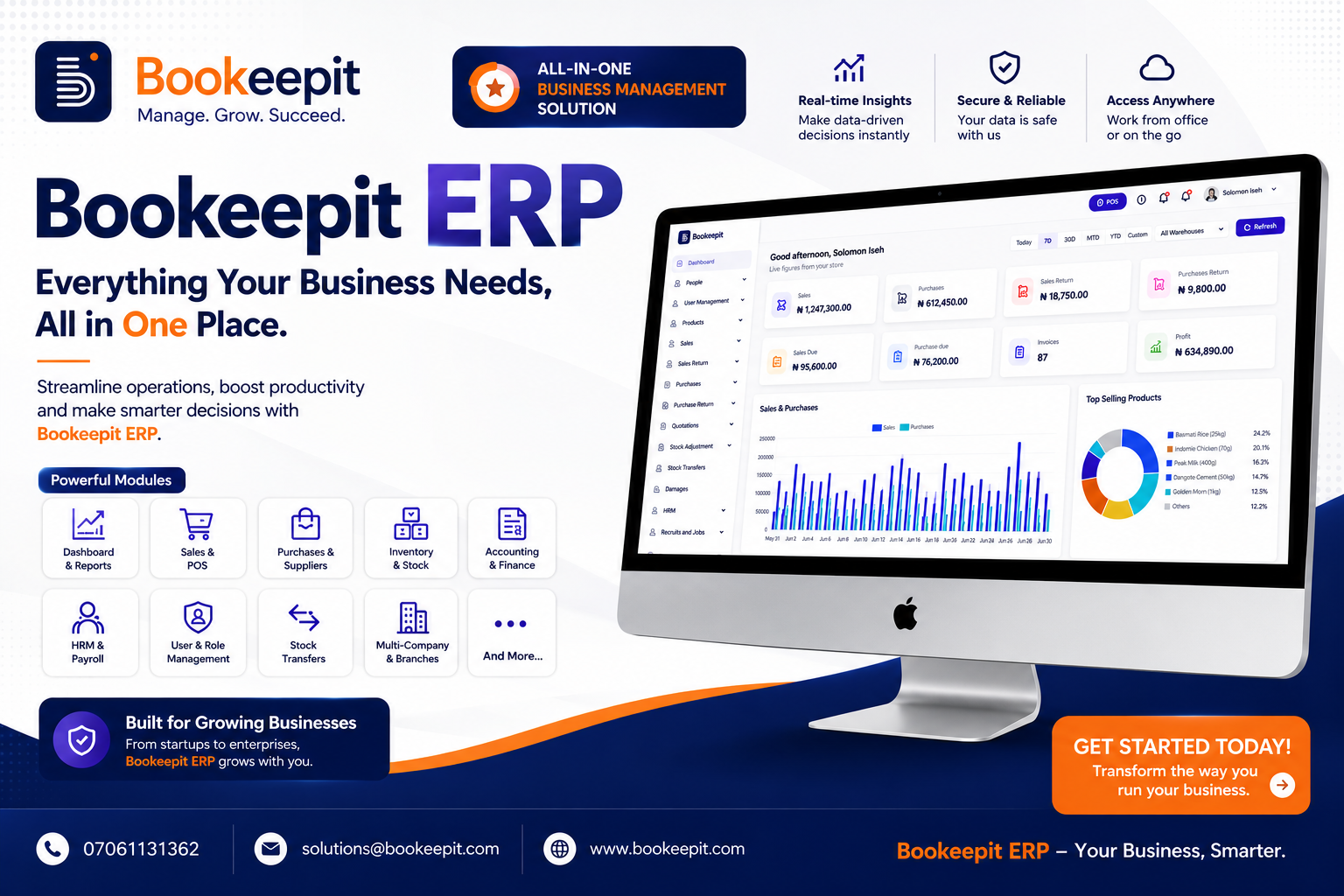
Bookeepit brings sales, POS, inventory, purchasing, expenses and accounting onto one platform built for Nigerian businesses, priced in naira and supported by a team in Lagos. From the Silver plan a branch can keep selling at the till when the internet drops, and HR, payroll and manufacturing come in on the higher plans.
You don't have to use everything on day one. For example:
Final thoughts
Good software should make running your business simpler. You shouldn't need five different systems, or five different spreadsheets, to understand your sales, stock, expenses and profit. Choose a platform that fits how you work today and can grow with you tomorrow.
Frequently asked questions
What is business management software?
It's a platform that helps you manage sales, inventory, purchasing, expenses, accounting, staff and reporting in one place.
What's the difference between POS and ERP software?
POS handles sales at the counter. ERP connects sales to inventory, purchasing, accounting and HR, so information flows between all of them.
Is ERP software suitable for small businesses?
Yes, especially modern cloud platforms that let you start with a few essential modules and add more as you grow.
Will business management software help with Nigeria's new tax rules?
It helps you keep the clean, digital records the new rules increasingly expect, which makes VAT and tax filing much easier. Speak to your accountant or tax adviser about your specific obligations.
Can it replace Excel?
For daily operations like sales, stock and expenses, yes. Many businesses still use Excel for one-off analysis, and that's fine.
Can Bookeepit manage multiple companies?
Yes. Bookeepit supports multiple companies with consolidated reporting.